

Undercounter Ice Machines
An undercounter ice machine makes ice and stores it in one cabinet, sized to slide under a bar, back counter or prep line. There is no separate bin to buy and no head to stack. You plug it in, run a water line and a drain, and it fills its own bin all day.
We carry nine self-contained undercounter models from Atosa and ITV. They range from 15.95" to 30" wide and make 77 to 340 lb of ice a day, in half-dice, full-dice and gourmet cubes. All nine run on a standard 115V outlet and use R290 refrigerant. Every order ships with free freight and free lift gate to a business address.
Atosa Ice Machines
-
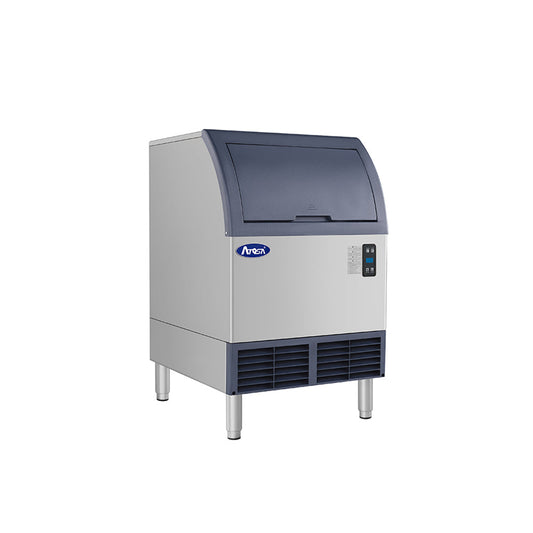
Atosa YRU0140A-161 25-Inch Undercounter Ice Machine, 140 lb/24 hr, 88 lb Bin, Half-Dice
Regular price $1,850.00 USDRegular price$2,756.00 USDSale price $1,850.00 USDSale -
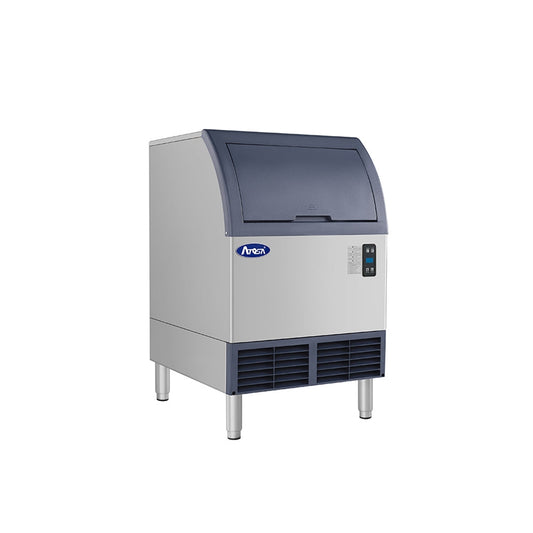
Atosa YRU0280A-161 25-Inch Undercounter Ice Machine, 280 lb/24 hr, 88 lb Bin, Half-Dice
Regular price $2,383.00 USDRegular price$3,551.00 USDSale price $2,383.00 USDSale


Undercounter Ice Machine Buying Guide
A commercial undercounter ice machine, also called an under counter ice machine or under the counter ice maker, puts fresh ice right where your staff serves it. Instead of hauling buckets across the kitchen or buying bagged ice, bartenders, servers and beverage staff pull from a dedicated supply at their station. Each one is a self-contained ice machine that combines the ice maker and an insulated storage bin in one cabinet, which makes it a natural fit for restaurants, cocktail bars, cafés, concession stands and other small commercial spaces where an under counter ice maker has to work hard in a tight footprint.
Not every machine called "undercounter" fits under every counter. Production, bin size, ventilation, drain placement and cabinet height all vary, and some larger models stand 38 to 39 inches on their legs. Picking the right one comes down to five things: how much ice you use on your busiest day, which cube you want, how much room you have, how hot that room gets, and what the site has for power, water and drain. The numbers below come straight from the Atosa and ITV spec sheets and manuals.
Every Undercounter Model We Carry
All nine are commercial undercounter ice makers built and listed for foodservice, not residential units. "Ice per day" is production: how much ice the machine makes in 24 hours under test conditions. "Bin" is storage: how much finished ice it holds at one time. A 140 lb per day machine with an 88 lb bin does not store 140 lb of ice. Ice makers are rated at 70°F room air and 50°F water; the hot-day column is the rating at 90°F air and 70°F water, which is closer to a real bar or kitchen in summer.
| Model | Cube | Ice per day | Hot day | Bin | W x D | Height on legs |
|---|---|---|---|---|---|---|
| ITV Delta NG 80 | Gourmet | 77 lb | 64 lb | 33 lb | 15.95" x 20.28" | 33.43" to 35.40" |
| ITV Delta NG 120 | Gourmet | 108 lb | 95 lb | 44 lb | 21.06" x 23.43" | 35.20" to 37.17" |
| ITV Delta NG 150 | Gourmet | 143 lb | 130 lb | 55 lb | 21.06" x 23.43" | 35.20" to 44.30" |
| ITV Spika NG 130 | Full or half dice | 134 lb | 103 lb | 44 lb | 21.07" x 23.43" | 35" to 37" |
| ITV Spika NG 160 | Full or half dice | 159 lb | 117 lb | 44 lb | 21.07" x 23.43" | 35" to 37" |
| ITV Spika NG 230 | Full or half dice | 223 lb | 157 lb | 77 lb | 25.99" x 27.56" | 39" |
| ITV Spika NG 360 | Full or half dice | 340 lb | 273 lb | 99 lb | 30" x 30" | 39" |
| Atosa YRU0140A-161 | Half dice | 140 lb | 105 lb | 88 lb | 24-1/4" x 28-3/4" | 38-1/2" |
| Atosa YRU0280A-161 | Half dice | 280 lb | 210 lb | 88 lb | 24-1/4" x 28-3/4" | 38-1/2" |
How Much Ice Do You Need?
Step 1: Count your busiest day. Use real covers, transactions or drink sales from your busiest realistic day, not your average Tuesday. Include every use of ice: drinks, cocktail shaking, food display, chilling bottles and back-of-house tasks. If summer weekends look very different from winter weekdays, plan for the season with the highest demand. A new business without sales history can start with expected covers and revisit the number after opening.
Step 2: Multiply by the figure for your business. ITV publishes how much ice different kinds of businesses use:
| Business | Ice used (ITV figure) | Example |
|---|---|---|
| Café | 0.09 lb per customer | 500 customers = 45 lb |
| Traditional bar | 0.22 lb per customer | 400 customers = 88 lb |
| Fast food, medium drinks | 0.24 lb per drink | 500 drinks = 120 lb |
| Standard restaurant | 0.33 lb per customer | 400 customers = 132 lb |
| Pub or club | 0.55 lb per customer | 200 customers = 110 lb |
| Full-service restaurant | 0.66 lb per customer | 250 customers = 165 lb |
| Night club | 0.66 lb per customer | 200 customers = 132 lb |
| Hotel | 0.66 lb per room | 100 rooms = 66 lb |
Step 3: Compare against the hot-day number. A full-service restaurant with 250 covers needs about 165 lb a day. On a hot day that rules out the Delta NG 150 (130 lb) and the Spika NG 230 (157 lb), and points to the Atosa YRU0280A-161 at 210 lb or the Spika NG 360 at 273 lb. Leave some margin for peak periods and growth, but bigger is not automatically better: space, power, water, drain and budget still matter.
Gourmet, Full Dice or Half Dice
Cube shape affects how ice looks in the glass, how fast it melts and how densely it fills a cup. Let your menu, glassware and the way staff scoop or dispense ice drive the choice, and confirm the cube for the exact configuration you order. If the ice will feed a beverage dispenser, check which ice types that equipment accepts.
Gourmet cubes come from the ITV Delta NG. Each cube is about 1.57" across and 1.73" tall. They are thick and slow to melt, which suits cocktails, whiskey and premium soft drinks where the ice is part of the presentation.
Full dice from the ITV Spika NG is about 1" x 0.9" x 1". It is a versatile, solid cube for general drink service and bagged ice.
Half dice packs tighter in a glass and cools a drink faster, which helps in fast-paced drink service. The Spika NG half dice is about 0.9" x 0.43" x 1". Atosa's undercounter models make a 3/8" x 7/8" x 7/8" half-dice cube. On a Spika NG, you pick full or half dice when you order.
Fitting It Under the Counter
Measure the opening, not the counter. Record clear width, depth and height, including counter overhangs, trim, plumbing, outlets and baseboards. Heights on legs run from 33.43" on the Delta NG 80 to 39" on the Spika NG 230 and 360, and the Atosa models stand 38-1/2" including their 6" legs. Never remove required legs or block ventilation to make a cabinet fit.
Width is usually the deciding number. The Delta NG 80 is the only model under 16" wide, the best fit when you need a small under counter ice maker or an under cabinet ice machine behind a bar. The Delta NG 120 and 150 and the Spika NG 130 and 160 share a 21" cabinet. The Atosa YRU models are 24-1/4", the Spika NG 230 is just under 26", and the Spika NG 360 needs a full 30".
Also leave room for the bin door to open fully, for staff to scoop safely, and for a technician to reach the filter and service points. Measure doorways, hallways and corners on the delivery route too.
Air-Cooled Machines and Ventilation
Every undercounter model we carry is air-cooled and runs on R290 natural refrigerant. An air-cooled ice machine pulls room air across its condenser and pushes the heat back out into the room. It needs no extra water line for cooling, which keeps installation simple, but it means the machine is only as good as the air around it. If hot exhaust air gets trapped and pulled back in, the machine runs longer, makes less ice and wears faster.
Where the air goes depends on the brand. ITV's Delta NG and Spika NG pull in and push out air through the front grille, so ITV designs them to be built in under a counter with cabinetry on both sides, as long as the front stays clear. Atosa's YRU models need at least 2" on each side and 1" on top, so plan an opening slightly larger than the cabinet.
- Keep the front clear. No boxes, mats, kick plates or cabinet doors over a front-vented grille.
- Keep heat away. Avoid spots beside fryers, ovens, dishwashers or the exhaust of another refrigerator or freezer.
- Keep it clean. A dusty condenser or clogged air filter acts like a blocked vent. Atosa says to clean the removable air filter and the condenser often so the machine can breathe.
Hot Rooms Make Less Ice
Production ratings are lab numbers. As room air and incoming water warm up, every ice machine makes less ice. Atosa's manual shows the YRU0280A-161 dropping from 280 lb at 70°F air and 50°F water to 210 lb at 90°F and 70°F, and to 168 lb at 100°F air and 90°F water. If the machine will sit next to a fryer line or behind a summer patio bar, size to the hot-day number and keep exhaust from nearby equipment, and stacked boxes, away from its vents.
Atosa rates its ice machines for 41°F to 110°F room air, 37°F to 90°F incoming water and 30 to 70 psi water pressure. ITV rates the Spika NG and Delta NG cabinets for hot (tropical, T class) climates.
Power, Water and Drain
Check these before delivery. A machine that fits but lacks the right circuit or drain sits unused while extra work gets scheduled.
- Power: all nine models run on 115V. The Atosa YRU models use a NEMA 5-15P plug, and Atosa lists a 10 amp breaker. Have an electrician confirm the outlet and circuit.
- Water: a cold potable water line with room nearby for a filter. Atosa ships a 3M ICE120-S filter system with each YRU model. For the ITV models, the matching filter is the ITV PRO-101K with the PRO-10 replacement cartridge.
- Drain: ice machines drain by gravity, so you need a floor drain or floor sink below the drain outlet. Atosa says to drop the drain line about 1" for every 3 feet of run. A nearby sink or a bucket is not a substitute; have a plumber confirm the route.
- Install: we do not offer installation. A plumber or refrigeration tech can set one up.
Water Quality and Maintenance Costs
Your water becomes your ice, so its quality shows up in the glass. Sediment and chlorine affect taste, odor and clarity, and hard water leaves mineral scale on the evaporator, the water pump and the water lines. Scale slows the ice harvest, cuts production, makes cloudy or misshapen cubes and is a common cause of service calls. A filter sized for the machine traps sediment and reduces chlorine and scale before the water reaches the ice maker. If your area has hard water, plan on changing cartridges and descaling more often.
Ongoing costs stay predictable when you plan for them. Budget for replacement filter cartridges about every 6 months, descaler and sanitizer for cleaning at least every 3 months, the staff time to do it, and electricity. Atosa lists about 7 to 7.5 kWh per 100 lb of ice on its undercounter models. Skipped maintenance costs more than the supplies: scale-related repairs and cleaning are not covered under Atosa's warranty, and ITV pairs its warranty with keeping the filter changed and the machine cleaned on schedule.
Ice is food, so the surfaces that make and hold it need a written cleaning schedule. Cleaning (descaling) and sanitizing are separate steps. Store the scoop outside the ice, never scoop with a glass, and log filter changes and service so maintenance does not depend on memory.
Scale is what wears out an ice machine. Atosa's manual says to clean and sanitize the machine and bin at least every 3 months, using the ATIMD01 descaler and then the ATIMR02 sanitizer, and to change the 3M cartridge about every 6 months, sooner with hard water. Atosa does not cover cleaning and maintenance under warranty.
The ITV Spika NG has a cleaning switch that circulates descaler without running the refrigeration, and ITV's seal-less pump is made to hold up in hard water. ITV recommends a water filter on every machine to control scale and chlorine. See all ice machine water filters.
Warranty
Compare whole-machine parts and labor separately from the longer compressor and evaporator coverage, and check the current warranty document for registration and maintenance conditions.
| Brand | Whole machine | Evaporator | Compressor |
|---|---|---|---|
| ITV Delta NG and Spika NG | 3 years parts and labor | 5 years parts and labor | 5 years parts, 3 years labor |
| Atosa YRU | 2 years parts and labor | 5 years | 5 years |
Atosa or ITV?
For a tight bar installation, width and airflow may settle it before brand does. For a high-volume restaurant, hot-day production and bin size matter more. Start with the need, then pick the brand.
The two Atosa undercounter machines give you the biggest built-in bin for the money: 88 lb on both models, with a 3M filter system in the box. Choose Atosa for a straightforward half-dice cube and the lowest cost per pound of ice. See every Atosa ice machine.
ITV gives you more choices: gourmet cubes from the Delta NG, full or half dice from the Spika NG, widths from 15.95" to 30", front ventilation for tight built-in spaces, and 3 years parts and labor on the whole machine. See every ITV ice machine.
Where Undercounter Ice Machines Work Best
Bars and cocktail lounges: an under bar ice machine keeps ice next to the bartender instead of in a back room. Premium cocktails may call for Delta NG gourmet cubes; a fast mixed-drink program may prefer full or half dice. Make sure the bin holds enough for the rush and that the door and scoop are easy to reach. When comparing under bar ice makers, width and front venting usually decide it.
Cafés and coffee shops: iced coffee, cold brew and tea create concentrated demand in warm weather. Count iced drinks, not total customers, and measure the counter opening carefully if you need a small commercial ice machine for a narrow counter.
Restaurants and quick service: include water service, fountain drinks, cocktails and kitchen use. If one machine serves both a bar and a dining room, size for the combined demand.
Hotels, break areas and concessions: easy access and steady replenishment matter more than maximum output. Decide who cleans the unit and confirm the drain before choosing a spot.
Daily Production Versus Storage Capacity
Think of production as a refill rate and the bin as a reserve. When the bin is full, the machine pauses; as staff remove ice, it makes more. A rated daily total is not a promise that a full day of ice is waiting at opening.
Imagine a restaurant using 165 lb a day, most of it during a two-hour dinner rush. A machine can cover that total on paper and still run dry mid-rush if the bin empties faster than new ice is made. If your demand comes in sharp peaks, the bin size and whether it starts the rush full can matter more than a small difference in daily production.
Undercounter vs. Modular Ice Machines
A commercial undercounter ice maker combines the ice-making head and bin in one cabinet, which keeps planning simple and puts ice at the point of service. A modular ice machine uses a separate head and storage bin, which suits operations that need more production, a bigger reserve or several serving points, at the cost of a larger footprint.
Choose undercounter when your production and peak storage fit a self-contained model and the service point is close. Consider modular when your demand exceeds the undercounter lineup or staff keep emptying the built-in bin during rushes.
Common Buying Mistakes to Avoid
- Sizing from the standard rating alone. Use the hot-day number for a hot kitchen or crowded bar.
- Forgetting installed height. Measure the opening with legs, clearances, plumbing and door swing included.
- Ignoring the drain. Confirm a gravity-drain route before you buy.
- Buying the wrong cube. Confirm gourmet, full dice or half dice before ordering.
- Planning for average days. Size for your busiest periods.
- Buying a residential unit. Many under counter ice makers sold for homes are not built or listed for commercial kitchens. Every machine here is NSF listed.
- Skipping maintenance planning. Make sure staff can reach the filter, bin and cleaning controls.
Undercounter Ice Machine FAQ
Does an undercounter ice maker need a drain?
Yes. Every model here drains by gravity to a floor drain or floor sink that sits below the machine's drain outlet.
Can I plug it into a regular outlet?
All nine models run on 115V. Atosa's YRU models use a standard NEMA 5-15P plug on a 10 amp breaker. Confirm the outlet with an electrician before delivery.
What is the smallest commercial undercounter ice machine you carry?
The ITV Delta NG 80, at 15.95" wide and 20.28" deep. It makes 77 lb of gourmet cubes a day and holds 33 lb.
Which one makes the most ice?
The ITV Spika NG 360 at 340 lb a day (273 lb on a hot day), with a 99 lb bin. If you need more than that, look at a modular ice machine on a separate bin.
How often do I clean it?
Atosa says at least every 3 months, with the filter cartridge changed about every 6 months. Hard water means more often for any brand.
Do you carry an undercounter nugget ice maker?
Not right now. Our undercounter ice makers make gourmet, full dice or half dice cubes. Half dice is the smallest cube in the lineup and packs tightest in a glass.
Is there an alternative to a Manitowoc undercounter ice machine?
Yes. If you are shopping Manitowoc or Hoshizaki undercounter ice machines, compare the hot-day production, bin size, width and warranty of the Atosa and ITV models above against the model you are considering.
How does shipping work?
Every Atosa and ITV ice machine ships with free freight and free lift gate to a zoned business address in the lower 48 states and Washington, DC. The driver lowers the machine to the curb or door. See Shipping & Returns for details.